Friday, 12 October 2012
Weekly Photocaption - 1
Silent guardian : A statue of four-time president of the Bombay Municipality, Sir Pherozeshah Mehta stands grim and solemn, ever watchful of the thousands of people that make their way through the busy Chhatrapati Shivaji Terminus everyday. Declared as a World Heritage site by UNESCO, the 124-year-old station is situated in South Bombay, an area of the city known for its striking Gothic architecture.
Labels:
CST,
Mumbai,
Mumbai Streets,
Photography,
Photos,
Railway,
Victoria Terminus
Saturday, 6 October 2012
The sky is crying
It would be almost impossible to express the magnificence of the events of this evening, but I hope the following photographs will do some justice.
| The gold rush. |
The skies were clear at 6:00 pm today, with no indication at all of any rain. At about 6:30 a light drizzle began with a pitter-patter of scattered drops, a child's first uncertain steps. Steadily, the sky began to turn into a mellow amber. The whole city was covered by a sepia filter, turning the streets into a Bollywood movie from the 70's. The sky was gold and the drops of rain shone through like molten glass falling form the heavens. Then, the rain began to build in intensity and reached a crescendo and the sky burst forth with an ominous boom. Almost like a chameleon changing colours, the scene turned from a glorious yellow hue to a pallid pink. The king had surrendered to the queen. Like a jubilant girl in a new dress, the heavens screamed in delight while water rained down in sheets.
Labels:
Bombay,
holy crap,
Life in Mumbai,
monsoon,
Mumbai Streets,
Photography,
Photos,
rains
Wednesday, 26 September 2012
The Silver (and red and blue) Lining
'Expect the unexpected' is always good advice to give anyone before they travel to Bombay. The city never ceases to amaze you more day by day. I was travelling in a friend's car a few days ago, and we were trying to negotiate our way through the inevitable Bombay traffic on an irritably humid afternoon. Bombay's motorists are not renown for their patience, and that day, it seemed even the elements were spoiling for a fight. As is the custom during long traffic jams, the air was filled with the exquisite cries of cars, buses, rickshaws and motorbikes as if it was mating season in the Serengeti. Frustrated taxi drivers swore loudly, cursing the mothers of anyone unfortunate enough to be within hearing distance while pedestrians and beggars zig-zagged amidst the chaos.
As we lurched forward inch by inch, constantly shifting between first gear and neutral, the sky began to darken. True to their nature, the Bombay rains had decided to show up unannounced. However, a far greater development was about to astonish me. A large SUV that we had been kissing bumpers with for the last few miles somehow managed to switch lanes, revealing a towing van (otherwise known as the arch nemesis of the parking-challenged) with Herbie on it! YES, THE CAR.
Labels:
Bombay,
Fully Loaded,
Herbie,
India,
Mumbai,
Photography,
Photos,
Streets,
Volkswagen Beetle
Wednesday, 19 September 2012
A Land of Paradoxes - Part 2
| A diamond in the rough. |
On a particularly warm and lazy Bombay afternoon a few days ago, I was standing in the balcony of a relative's place in a sort-of upper suburban part of the city, and I happened to notice a small cluster of ramshackle tarpaulin and corrugated tin roofs nestled between a clump of trees. Even though these are a common sight throughout Bombay, they are often more striking when seen against the backdrop of a concrete jungle. I stood and watched in fascination while people below navigated through the claustrophobic lanes and went about their daily business, perhaps completely oblivious to the happenings of the world around them. While a woman occupied herself with hanging her clothes to dry, a group of very young children played with stray pups, their squeals of laughter reaching all the way up to the 8th floor. Meanwhile, a man attempted to fix his makeshift roof with what looked like a large plastic sheet, placing heavy stones over it so that it would withstand the wind and rain.
Labels:
Bombay,
Dharavi,
India,
Mumbai,
Photography,
Photos,
Slumdog Millionaire,
Slums,
Streets
Sunday, 16 September 2012
A Land of Paradoxes - Part 1
It's a commonly known fact now that Bombay is home to one of the biggest slums in the world. With a total estimated population of over 9 million (over 60% of the city's people) the slums of Bombay are a mini-metropolis of their own, leading through the winding narrow lanes of Dharavi and along the local railway lines that span the length of the city. Easily identifiable as being an endless cluster of makeshift shanties and huts, Dharavi is a city in a city. Director Danny Boyle even went so far as to romanticize the slum's poverty in his Academy Award winning film Slumdog Millionaire. The movie was monumental in bringing the slums of Bombay under the global spotlight, and sparking interest from all corners of the world. However, it also brought forth a deluge of misconceptions about the city.
While the fact remains that the majority of the city is still shackled by the chains of economic distress, a largely undocumented feature is the amount of resilience shown by the people. While you may read about how an extended family of eight are crammed into a tiny 8x8 room where they have to manage all their cooking, cleaning and washing up, you won't read about how the population of the slum have developed into a controlled ecosystem, capable of sustaining themselves, albeit barely.
You may read about the lack of toilets, drinking water and electricity, but you won't read about how people manage to get along fine without needing them. You won't read about how hundreds of people know each other by name and manage to live together in perfect harmony, while barely managing to avoid stepping on each other's toes. You will not read about how despite all odds, the fires of industry still burn throughout the night in Dharavi, giving life to small businesses and allowing people to scrape a living. You will not read about how when the day comes to a close and the oil lanterns begin to fade, the laughter of children still rings out clear through the seemingly empty streets.
The slums are also an excellent option for cheap accommodation, for those who aren't squeamish about the lack of facilities. It also poses as a safe haven for people to slip under the radar and disappear, if they so desire. However, while these facts may surprise and intrigue you, they will probably not come to you as that much of a shock as what I am about to reveal in my next post. Stay tuned.. :)
Part 2 is here.
| Dharavi : A city within a city |
![]() |
| A pottery establishment |
![]() |
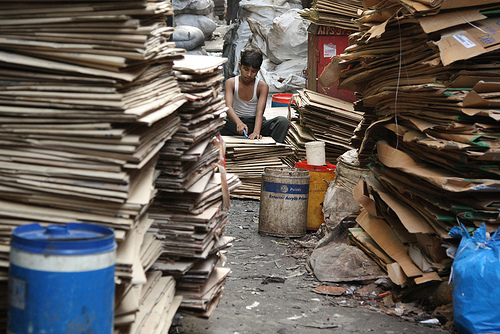
A man removes staples from cardboard boxes to sell as scrap metal
|
While the fact remains that the majority of the city is still shackled by the chains of economic distress, a largely undocumented feature is the amount of resilience shown by the people. While you may read about how an extended family of eight are crammed into a tiny 8x8 room where they have to manage all their cooking, cleaning and washing up, you won't read about how the population of the slum have developed into a controlled ecosystem, capable of sustaining themselves, albeit barely.
You may read about the lack of toilets, drinking water and electricity, but you won't read about how people manage to get along fine without needing them. You won't read about how hundreds of people know each other by name and manage to live together in perfect harmony, while barely managing to avoid stepping on each other's toes. You will not read about how despite all odds, the fires of industry still burn throughout the night in Dharavi, giving life to small businesses and allowing people to scrape a living. You will not read about how when the day comes to a close and the oil lanterns begin to fade, the laughter of children still rings out clear through the seemingly empty streets.
![]() |
| Even though money may be scarce, the smiles aren't. |
Part 2 is here.
Labels:
Bombay,
Dharavi,
India,
Mumbai,
Photography,
Photos,
Slumdog Millionaire,
Slums,
Streets
Friday, 14 September 2012
The Sifting Winds
A wind blew through the snow covered
Kashmir hills, as it passed through the Himalayan ranges, twisting and coursing
through the minute gaps, it split into two- Raging above the craggy peaks, blowing
through the deep crevices. Drifting onwards, ever ahead. The wind crossed the
high mounts moving onto the sifting dunes of the Thar Desert, finally blowing
by the western coast, creeping towards its final destination.
Through the bottomless depths, the
wind surged ahead, onto the sea-green plains of Bengal, undulating through the
grasslands. It blew on, towards the southern states, carrying with it the
dreams and hopes of a billion souls. Softly as a wave it moved ahead, now
climbing up, again going down, ever inching ahead. And then the two became one,
the many partitions coming together in a fiery conflagration above the city of
Mumbai. Blowing with renewed vigour, it coalesced into one, forming the soul of
Mumbai, made up of the hopes and aspirations of countless Indians. Unifying
into one, the great soul of the lively city was formed – A merger comprising of
all facets of India - thrumming with vibrance, drumming with fervor.
Subscribe to:
Posts (Atom)